Best Business Email Providers for Privacy and Security in 2026
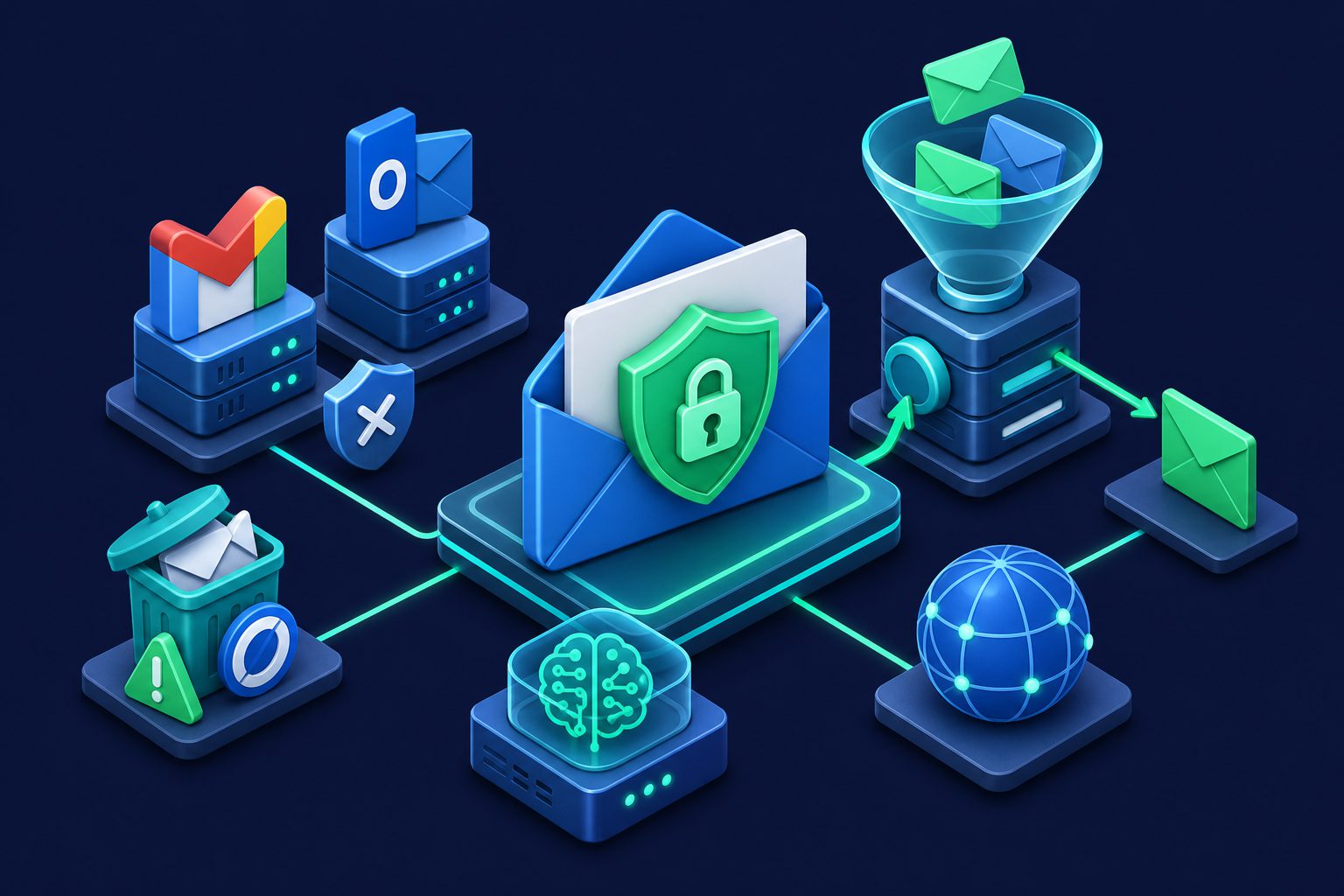
If you run a business, your email provider sees every message your company sends and receives. Client negotiations, financial documents, employee communications, legal discussions — all of it passes through servers controlled by your email provider. For most businesses, that provider is Google or Microsoft.
Both are competent email platforms. Neither is a privacy-first choice. Google scans email for Smart Features and builds advertising profiles. Microsoft telemetry collects usage data across the 365 suite. If your business handles sensitive information — or if you simply believe company communications should stay private — there are better options.
What to look for in a business email provider
Privacy-focused business email is not the same as privacy-focused personal email. Businesses need features that individual users do not:
- Custom domain support — Email from
you@yourcompany.com, not a generic provider domain - Multi-user management — Add and remove employee accounts with role-based permissions
- Admin controls — Centralized management of security policies, shared contacts, and distribution groups
- Compliance tools — Depending on your industry: audit logging, data retention policies, export capabilities
- Reliability — Business email downtime directly costs money. You need proven uptime and redundancy.
- Migration support — Moving an entire company's email is painful. Good providers offer tools and assistance.
The providers below meet these requirements while also prioritizing data privacy.
The best privacy-focused business email providers
ProtonMail for Business
ProtonMail is the most well-known privacy email provider, and their business plans extend zero-knowledge encryption to teams. ProtonMail cannot read your email even if compelled by a court order — they do not have the encryption keys.
- Encryption: End-to-end between Proton users. PGP for external contacts. At-rest encryption for all stored email.
- Jurisdiction: Switzerland, outside EU/US jurisdiction, strong privacy laws
- Custom domains: Yes, with full DNS setup (MX, SPF, DKIM, DMARC)
- Admin panel: User management, security policies, catch-all addresses
- Price: From $7.99/user/month (Mail Essentials) to $12.99/user/month (Business)
- Limitation: The web and mobile apps are the primary interface. IMAP/SMTP access requires Proton Bridge, which adds complexity and does not support all third-party clients equally.
Tuta (formerly Tutanota) for Business
Tuta takes a similar approach to ProtonMail but with its own encryption protocol instead of PGP. Like ProtonMail, Tuta is zero-knowledge — they cannot access your email content.
- Encryption: End-to-end between Tuta users. Symmetric encryption for external contacts (password-protected messages). Full at-rest encryption.
- Jurisdiction: Germany, subject to strict data protection under GDPR
- Custom domains: Yes
- Admin panel: User management, whitelabel options on higher plans
- Price: From $6/user/month (Revolutionary) to $8/user/month (Legend)
- Limitation: No IMAP/SMTP access at all. You must use Tuta's apps. No third-party client support. This is a dealbreaker for businesses that rely on specific email clients.
Fastmail for Business
Fastmail is not zero-knowledge encrypted, but it is a strong privacy choice for a different reason: it has no advertising business. Fastmail makes money from subscriptions, not data. There is no scanning, no profiling, and no ad-tech integration.
- Encryption: TLS in transit, at-rest encryption on their servers. Not end-to-end.
- Jurisdiction: Australia (adequate privacy protections, no mass surveillance agreements targeting email content)
- Custom domains: Yes, with excellent DNS tooling
- Admin panel: Full multi-user management, shared calendars, contacts
- Price: $6/user/month (Standard) to $10/user/month (Professional)
- Advantage: Full IMAP/SMTP support, works with every email client. Excellent CalDAV/CardDAV. Fast, polished web interface. The most "normal email experience" on this list.
Mailfence for Business
Mailfence is a Belgian provider that combines standard email with optional end-to-end encryption (OpenPGP and S/MIME). It sits between Fastmail's usability and ProtonMail's encryption focus.
- Encryption: Optional end-to-end via OpenPGP and S/MIME. At-rest encryption. Not zero-knowledge by default.
- Jurisdiction: Belgium, strong EU privacy protections
- Custom domains: Yes
- Admin panel: User management, group aliases, shared resources
- Price: From $3.50/user/month to $9/user/month
- Advantage: Built-in documents, calendar, and contacts. PGP key management in the web interface. IMAP/SMTP supported.
Comparison table
| Provider | E2E encryption | IMAP/SMTP | Jurisdiction | Price (per user/mo) | Best for |
|---|---|---|---|---|---|
| ProtonMail Business | Yes (zero-knowledge) | Via Bridge | Switzerland | $7.99-$12.99 | Maximum encryption |
| Tuta Business | Yes (zero-knowledge) | No | Germany | $6-$8 | Budget encryption |
| Fastmail Business | No | Yes | Australia | $6-$10 | Usability + privacy |
| Mailfence Business | Optional (PGP/S/MIME) | Yes | Belgium | $3.50-$9 | Flexible encryption |
What about Gmail and Outlook?
Google Workspace and Microsoft 365 are not privacy-focused, but they are competent and widely used. Here is what you are giving up:
- Google Workspace: Email is scanned for Smart Features (travel itineraries, package tracking, autocomplete suggestions). While Google says they do not read email for ad targeting on Workspace accounts, the data processing still happens on Google's servers under Google's terms. Price: $7-$18/user/month.
- Microsoft 365: Telemetry collection across the suite. Email content processed for Microsoft's AI features (Copilot, suggested replies). GDPR compliance available but requires careful configuration. Price: $6-$22/user/month.
Both offer excellent spam filtering, massive storage, and deep integration with productivity tools. The tradeoff is clear: convenience and ecosystem vs. privacy and data sovereignty.
The missing piece: inbound protection
Choosing a privacy-focused provider protects your data at rest and in transit. But it does not protect you from what arrives in your inbox. Spam, phishing, and malicious attachments are inbound threats that require a different solution.
This is where Cleanbox fits into the picture. Regardless of which email provider you choose, Cleanbox sits in front of it as an inbound protection layer:
- Relay — Point your domain's MX records to Cleanbox, which filters all inbound email through Rspamd, virus scanning, and AI classification before forwarding clean messages to your provider. Works with ProtonMail, Fastmail, Tuta, or any SMTP-compatible server.
- Aliases — Give each department, project, or external contact a unique alias. If one is compromised, disable it without affecting the rest of the company.
- Shield — Rate-limit senders, schedule delivery windows (no email outside business hours), and enable Gatekeeper for addresses that should only receive mail from approved senders.
- Team management — Granular permissions let team members manage their own aliases and contacts without admin access to the entire account.
The combination of a privacy-focused provider (handling storage and sending) with Cleanbox (handling inbound filtering and alias management) gives you both privacy and protection — two things that most providers treat as separate concerns.
For more on setting up email for a custom domain, see How to Set Up Email DNS Records and Best Email Spam Protection for Custom Domains.
Ready to take control of your inbox?
Start protecting your email with Cleanbox — free plan available, no credit card required.
Get started free