Is ProtonMail Safe? Privacy and Security Reviewed
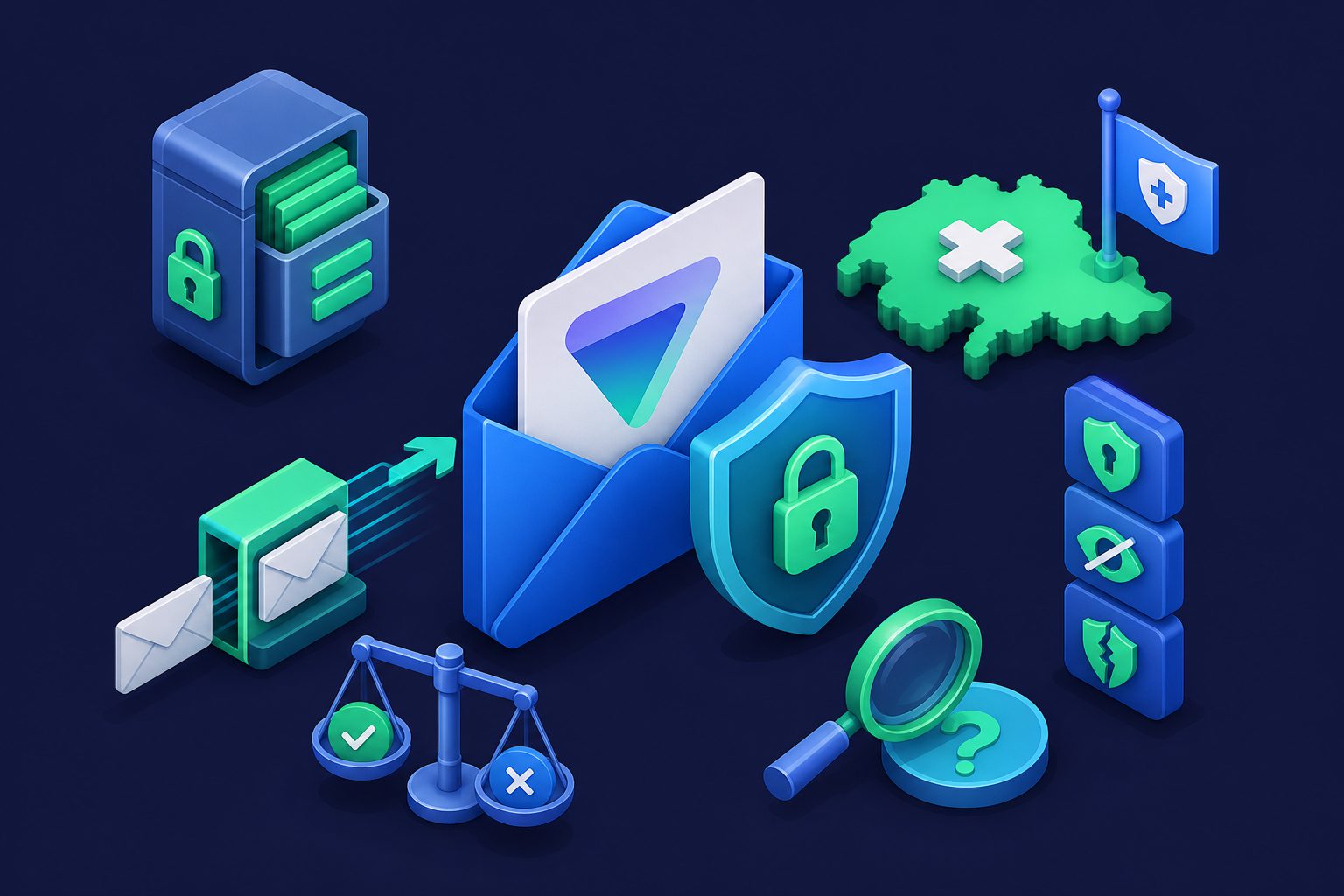
Proton Mail is the most recommended privacy email service in the world. Search for “private email” and Proton appears in every list, every recommendation thread, every privacy guide. The pitch is compelling: end-to-end encryption, Swiss privacy laws, open source, and a company that was founded at CERN specifically to build private communication tools.
Most of that is true. But the full picture is more nuanced than the marketing suggests. This review covers what Proton Mail actually protects, what it does not, and where the tradeoffs are.
Security: what Proton Mail does well
End-to-end encryption
Proton Mail’s core feature is end-to-end encryption (E2EE) between Proton users. When two Proton Mail users email each other, the message is encrypted on the sender’s device and only decrypted on the recipient’s device. Proton cannot read the content, even if compelled by a court order.
This is genuine and meaningful. Gmail, Outlook, Yahoo, and iCloud Mail can all read your email on their servers. Proton cannot. For communication between Proton users, this is the strongest consumer email encryption available.
Zero-access encryption
Even emails from non-Proton senders (which arrive unencrypted via standard SMTP) are encrypted at rest on Proton’s servers using your account key. Proton calls this “zero-access encryption.” It means that even if Proton’s servers are breached, stored emails are encrypted and unusable without individual account keys.
Swiss jurisdiction
Proton is headquartered in Geneva, Switzerland. Swiss privacy law is among the strongest in the world. Proton is not subject to US PATRIOT Act requests, EU data retention directives (Switzerland is not in the EU), or Five Eyes intelligence sharing agreements. Swiss courts must approve any data request, and the bar is high.
Open source
Proton Mail’s clients (web, mobile, desktop) are open source and have been independently audited. The encryption implementation is verifiable. This is important because encryption claims are meaningless without the ability to verify them.
Where Proton Mail falls short
Encryption only works between Proton users
This is the biggest misconception about Proton Mail. When you email a Gmail user from Proton, the message is encrypted in transit (TLS) but arrives at Google’s servers in plaintext. Google can read it. The NSA can subpoena it. Your end-to-end encryption is only end-to-end when both ends use Proton.
Proton offers password-protected emails for non-Proton recipients, but the recipient has to click a link and enter a password you shared separately. In practice, almost nobody does this for regular communication. Most Proton users are emailing non-Proton users most of the time, which means most of their email is not end-to-end encrypted.
Metadata is not encrypted
Proton encrypts email content but not metadata. Subject lines, sender addresses, recipient addresses, timestamps, and IP addresses (of connecting clients) are not end-to-end encrypted. Proton has access to who you email, when, and how often. This metadata alone reveals significant information about your communication patterns.
Proton does not log IP addresses by default, but Swiss law can compel them to start logging for a specific account. This has happened — in 2021, Proton provided the IP address of a French climate activist to Swiss authorities under a valid legal request. Proton was legally required to comply, and the metadata was available because encryption does not cover it.
Spam filtering limitations
Proton’s spam filter is weaker than Gmail’s or Outlook’s. Because Proton cannot scan encrypted email content on the server side, its spam detection relies more heavily on sender reputation and metadata analysis. For emails from non-Proton senders (which arrive unencrypted), Proton can apply content filtering, but its dataset is a fraction of Gmail’s 1.8 billion users.
The result: more spam reaches your Proton inbox than would reach your Gmail inbox. For a comparison of how major providers handle spam, see Gmail vs Outlook Spam Filters.
Limited ecosystem
Proton offers Mail, Calendar, Drive, VPN, and Pass. The suite is growing, but it is not comparable to Google Workspace or Microsoft 365 in features or integrations. Proton Calendar cannot sync with most third-party apps. Proton Drive has limited storage on free plans. If you rely on deep integration between email, calendar, documents, and other tools, Proton requires compromises.
Search limitations
Because email is encrypted, server-side search is limited. Proton has implemented local search indexing on desktop and mobile, but it is slower and less comprehensive than Gmail’s instant search across your entire archive. For users with large archives who search frequently, this is a real usability gap.
Free tier limitations
Proton Free gives you 1 GB of storage, 1 email address, and 150 messages per day. This is restrictive. A single year of email can easily exceed 1 GB, especially with attachments. The free tier works as a trial but not as a long-term primary email. Paid plans start at 3.99 EUR/month.
Proton Mail compared to other providers
| Category | Proton Mail | Gmail | iCloud Mail | Tuta |
|---|---|---|---|---|
| E2E encryption | Yes (Proton-to-Proton) | No | No | Yes (Tuta-to-Tuta) |
| Zero-access storage | Yes | No | No | Yes |
| Spam filtering quality | Basic | Excellent | Basic | Basic |
| Free storage | 1 GB | 15 GB | 5 GB | 1 GB |
| Ad targeting | None | Profile-based | None | None |
| Open source | Yes | No | No | Yes |
| Custom domains | Paid only | Workspace only | No | Paid only |
| Jurisdiction | Switzerland | United States | United States | Germany |
For detailed reviews of other providers, see Is Gmail Safe?, Is iCloud Mail Safe?, Is Outlook Safe?, and Is Yahoo Mail Safe?
Who Proton Mail is right for
- Journalists and activists who face targeted surveillance and need encrypted communication with known contacts (who also use Proton).
- Privacy-conscious individuals who want to minimize their data footprint with email providers and are willing to trade features for privacy.
- People in the Proton ecosystem already using Proton VPN, Pass, or Drive — the integrated experience is genuinely good.
Who should look elsewhere
- People who email mostly non-Proton users — your encryption advantage disappears for most of your communication.
- Users who need strong spam filtering — Proton’s filter is not competitive with Gmail or dedicated filtering services.
- Custom domain owners who want email protection — Proton offers custom domains but not MX-level spam filtering or relay protection.
- Teams needing collaboration tools — Proton’s suite is not a Google Workspace replacement.
How Cleanbox complements Proton Mail
Proton Mail excels at encryption and privacy. It is weaker at spam filtering and does not offer MX-level domain protection. Cleanbox fills both gaps:
- Spam filtering before Proton: Route your custom domain through Cleanbox first. Every message passes through Rspamd scoring, DNSBL checks (Spamhaus, Barracuda, SpamCop), SPF/DKIM/DMARC verification, ClamAV scanning, and AI classification. Clean email is forwarded to your Proton mailbox. Spam is caught before Proton’s limited filter has to deal with it.
- Aliases without Proton’s limits: Proton bundles SimpleLogin for aliases, but only on paid plans. Cleanbox includes aliasing on all plans with per-alias spam thresholds and contact management built in.
- MX relay for custom domains: Cleanbox Relay acts as your domain’s MX gateway, filtering everything at the infrastructure level. Proton does not offer this.
- Quarantine with transparency: Borderline messages are held with detailed spam reports. No legitimate email is silently lost.
You keep Proton’s encryption for privacy. Cleanbox adds the filtering and protection layers Proton does not have. For a broader comparison of privacy-focused options, see Best Email Providers for Privacy in 2026.
Ready to take control of your inbox?
Start protecting your email with Cleanbox — free plan available, no credit card required.
Get started free