The Real Cost of Email Spam for Businesses
When people think about spam, they think about annoyance. A cluttered inbox. Deleting a few junk messages each morning. Mildly irritating, but harmless.
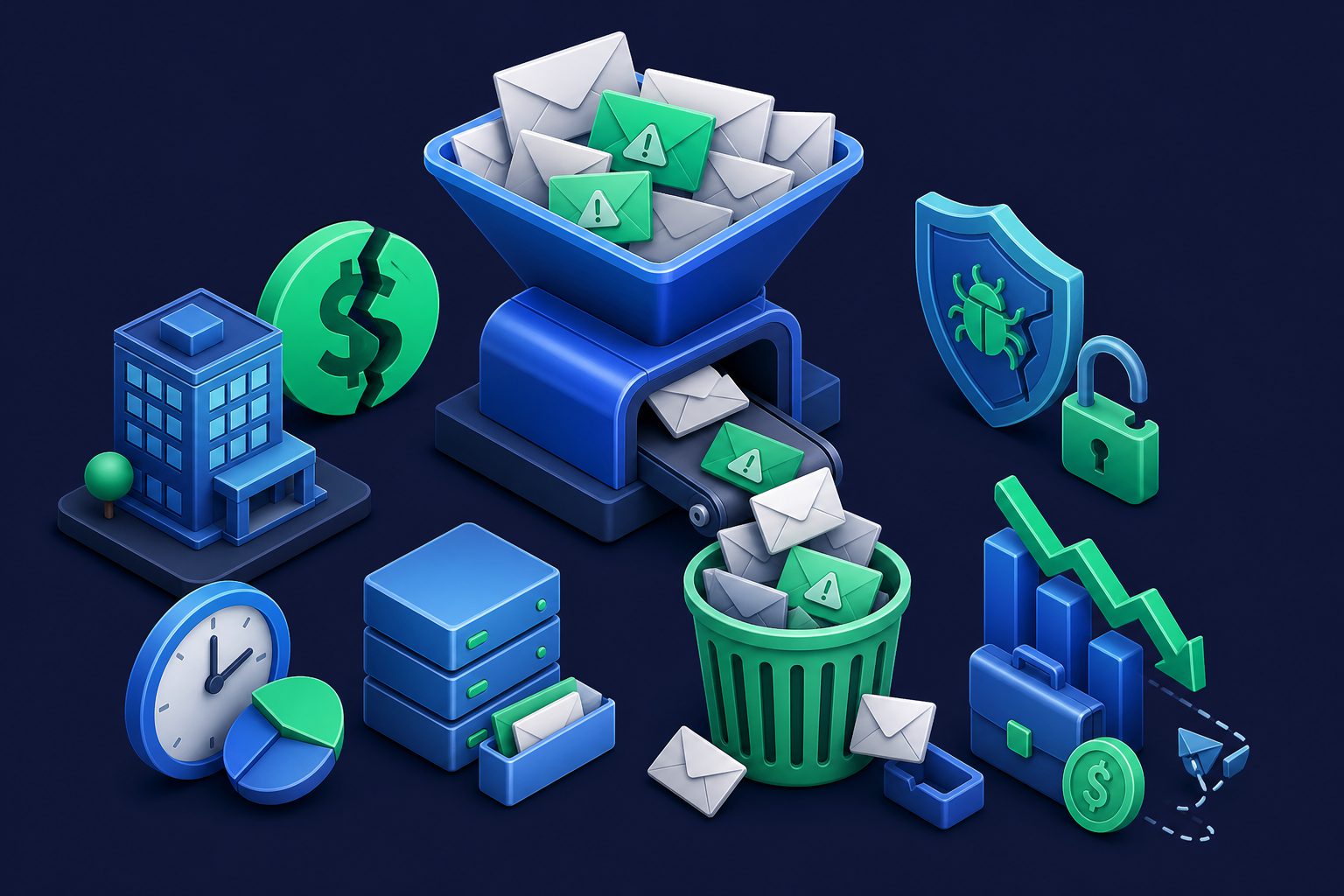
For businesses, the reality is different. Spam costs money in ways that do not show up on any invoice: employee time spent sorting email, security incidents caused by phishing that slipped through, storage costs for messages nobody wanted, and the invisible cost of legitimate email that was lost because the filter was too aggressive or too lenient.
The productivity cost
The average office worker receives 120 emails per day. Studies consistently show that 45-50% of all email sent globally is spam. Even with a good filter catching 99% of it, that still means several spam messages per day per employee that require attention — opening, evaluating, deleting, or reporting.
Each spam message that reaches an inbox takes an average of 5-10 seconds to process. That does not sound like much until you multiply it across an organization:
- 10 spam messages per day per employee (conservative with a 99% filter)
- 8 seconds average handling time per message
- 250 working days per year
- That is 5.5 hours per employee per year spent on spam
For a 50-person company, that is 275 hours per year — nearly 7 full work weeks — spent on junk email. At an average loaded cost of $50/hour, that is $13,750 per year in pure productivity loss. And 10 spam messages per day is conservative for public-facing addresses like info@ or support@.
The security cost
Productivity loss is predictable and manageable. Security incidents are neither. A single successful phishing attack that arrives as spam can cost a business anywhere from $10,000 (credential compromise, incident response) to millions (ransomware, data breach, regulatory fines).
The numbers are stark:
- Over 90% of cyberattacks begin with a phishing email
- The average cost of a business email compromise is $125,000
- Small businesses are targeted disproportionately because they lack enterprise security infrastructure
- AI-generated phishing is making these attacks harder to detect and more convincing
Every spam message that reaches an employee inbox is a potential attack vector. The more spam that gets through, the higher the probability that someone clicks the wrong link on the wrong day.
The storage cost
Email storage seems cheap until you account for volume. Spam that passes filters gets stored, backed up, indexed, and archived. For businesses with compliance requirements (healthcare, finance, legal), email retention policies mean spam is stored alongside legitimate correspondence for years.
Cloud email pricing is typically per-user, with storage limits. Spam that consumes storage pushes businesses toward higher tiers sooner. On-premise email servers pay for storage directly — disks, backup infrastructure, and the IT staff to manage them.
The storage cost is often invisible because it is bundled with legitimate email costs. But for a 100-person company receiving 50 spam messages per person per day (before filtering), that is 5,000 spam messages daily. Even filtered to a quarantine, that data exists somewhere and costs money to retain.
The missed message cost
This is the cost that nobody tracks because it is invisible by definition. When a spam filter is too aggressive, legitimate messages disappear. A sales inquiry from a potential client lands in quarantine and expires. A vendor invoice gets flagged and the payment is late. A customer complaint is missed and becomes a public review.
Studies estimate that 0.1-1% of legitimate business email is incorrectly flagged as spam. For a company receiving 6,000 legitimate messages per day, that is 6-60 messages lost daily. Most are recovered (if quarantine exists), but some are not. And the ones that are not recovered are, by definition, the ones nobody knew about.
For more on this tradeoff and how to manage it, see How to Reduce Spam Without Losing Legitimate Emails.
The IT management cost
Someone has to manage spam filtering. For businesses using cloud email (Google Workspace, Microsoft 365), this means configuring policies, reviewing quarantine, handling user complaints about false positives, and investigating security incidents. For businesses running their own mail infrastructure, add server maintenance, filter updates, blocklist management, and ongoing tuning.
IT teams spend an estimated 15-25% of their email management time on spam-related tasks. For a company with a dedicated IT person or team, that is a significant chunk of expensive labor that could be spent on productive work.
The compliance cost
Regulated industries (healthcare, finance, government) have additional costs. Email containing sensitive data must be protected. Spam that contains phishing links or malware and reaches employee inboxes becomes a potential compliance incident. Even if nobody clicks, the fact that the message reached a regulated environment may require documentation and reporting.
CAN-SPAM and GDPR also create obligations around email handling. Businesses that fail to properly manage unsolicited email risk regulatory attention, especially if customer data is compromised through a spam-borne attack.
What actually reduces the cost
Filter before delivery, not after
The cheapest spam message is one that never reaches your infrastructure. Filtering at the MX level — before email touches your mail server — eliminates storage costs, reduces the attack surface, and means employees never see the message. An MX relay that sits in front of your mail server catches spam before it arrives, not after.
Use multi-layer detection
Single-layer filtering (content analysis alone, or reputation alone) has blind spots that create both false positives and false negatives. Multi-layer detection — authentication, reputation, content scoring, AI classification — catches more spam with fewer false positives, reducing both security risk and missed-message costs. See How Spam Filters Work for how these layers interact.
Implement quarantine with review
Silent deletion is the most expensive spam filtering mistake a business can make. Every silently deleted legitimate message is a missed opportunity, a delayed payment, or a lost customer. Quarantine with easy review and release turns permanent loss into temporary delay.
Set per-address thresholds
A CEO’s inbox and a public support@ address have different risk profiles. Per-address spam thresholds let you be aggressive where spam is heavy and careful where false positives are costly.
How Cleanbox reduces these costs
Cleanbox addresses every cost category directly:
- Productivity: Multi-layer filtering (Rspamd, DNSBL, AI classification, ClamAV) catches spam before it reaches inboxes. Less spam means less time wasted sorting.
- Security: Every incoming message is checked against Spamhaus, Barracuda, and SpamCop blocklists, verified for SPF/DKIM/DMARC, scanned for malware, and analyzed by an AI classifier. Phishing attacks are stopped at multiple layers.
- Storage: For domains using Cleanbox Relay, spam is rejected before reaching your mail server. No storage cost for messages that never arrive.
- Missed messages: Quarantine holds borderline messages with detailed spam reports explaining why each was flagged. Nothing is silently deleted. Reviewing and releasing false positives takes seconds.
- IT management: Cleanbox handles the filtering infrastructure. No servers to maintain, no blocklists to update, no filter rules to write. Your IT team focuses on productive work.
For a small business, the cost of spam filtering through Cleanbox is a fraction of what spam itself costs in lost time, security risk, and missed messages. The math is straightforward: if spam costs your team 275+ hours per year, even basic filtering pays for itself in the first month.
Ready to take control of your inbox?
Start protecting your email with Cleanbox — free plan available, no credit card required.
Get started free